

AI Agent Automation for Logistics: Streamline Operations, Improve Customer Communication & Accelerate Deliveries
Logistics automation simply means helping logistics companies automate customer communication, shipment tracking, delivery updates, support requests, and operational workflows across multiple communication channels such as WhatsApp, Facebook Messenger, Instagram, Telegram, and Website Chat.
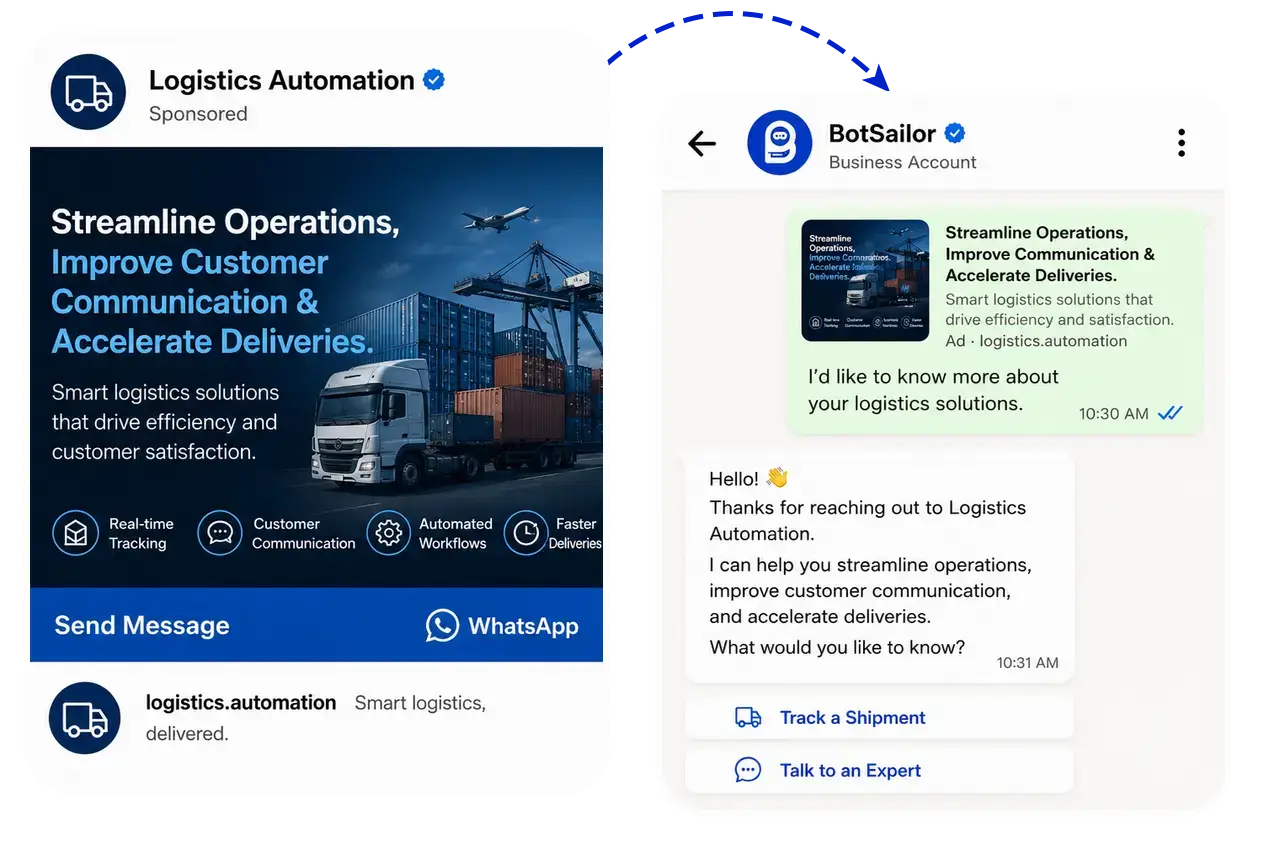
Communication Is a Growth Factor for Logistics
2026 Customer Expectations
The logistics industry has become increasingly fast-paced and customer-driven. In 2026, customers expect real-time shipment updates, instant responses, accurate delivery information, and seamless communication throughout the entire delivery process. Logistics businesses that fail to meet these expectations often struggle with customer dissatisfaction, delayed responses, and operational inefficiencies.
- Real-time shipment updates
- Instant responses
- Delivery information
- Transit status
- Pickup scheduling
- Failed delivery support
From Couriers to Supply Chain
From courier services and freight companies to eCommerce fulfillment providers and supply chain operators, communication plays a critical role in operational success. AI chatbot automation enables logistics businesses to handle thousands of customer interactions efficiently while improving service quality and reducing manual workload.
Shipment support
Tracking requests
Smarter automation
Logistics Industry Pain Points
Managing logistics operations involves far more than simply moving goods from one place to another. Modern logistics companies must manage shipment tracking, customer communication, delivery coordination, driver communication, support requests, order status inquiries, and route management.
Here are some major challenges logistics companies commonly face:
High Volume of Shipment Tracking Requests
Customers constantly ask: Where is my package? Has my order shipped? What is the delivery status? When will my shipment arrive? Is my package delayed? Without automation, support teams become overwhelmed, response times increase, and customer satisfaction decreases.
Delayed Customer Communication
Customers expect immediate updates regarding dispatch confirmations, transit status, delivery schedules, delivery delays, and failed delivery attempts. Delayed communication often leads to customer frustration, increased support tickets, and reduced trust.
High Manual Workload
Logistics teams spend significant time answering shipment inquiries, updating delivery statuses, coordinating drivers, managing customer requests, and handling repetitive support questions. This reduces operational efficiency and increases labor costs.
Lack of 24/7 Customer Support
Logistics operations continue around the clock. Customers may need assistance late at night, during weekends, across different time zones, and during holidays. Without automation, customers cannot access information instantly, support requests accumulate, and service quality declines.
Poor Delivery Follow-Up Process
Many logistics businesses struggle to confirm deliveries, collect customer feedback, handle failed deliveries, send delivery reminders, and re-engage inactive customers—resulting in reduced customer satisfaction and lower retention rates.
Benefits of Logistics Automation
AI chatbots help logistics companies by improving customer communication, automating shipment tracking, reducing support workload, increasing operational efficiency, and enhancing delivery experience.
Enhancing Customer Communication & Engagement
Chatbots provide customers with instant access to shipment information and support. They answer delivery questions, provide tracking updates, share shipment status, explain delivery processes, and handle FAQs instantly—improving satisfaction and building trust through transparency.
Improving Operational Efficiency
Logistics businesses often struggle with massive inquiry volumes and repetitive support requests. Automation provides shipment status automatically, collects delivery information, routes support requests, and escalates complex issues—reducing operational bottlenecks.
Streamlining Support & Reducing Costs
Customers can track shipments instantly, receive updates automatically, request assistance anytime, and resolve common issues without waiting—freeing support agents to focus on higher-priority operational tasks.
Key Features of a Logistics Automation Chatbot
Chatbot automation helps bridge the gap between customer expectations and logistics operations.
Shipment Tracking Automation
Customers can instantly track packages, check delivery status, view shipment progress, and receive estimated arrival times. No waiting. No support tickets.
Delivery Status Notifications
Chatbots automatically send shipment confirmations, dispatch alerts, transit updates, out-for-delivery notifications, and delivery confirmations—keeping customers informed throughout the journey.
Pickup Scheduling Automation
Customers can request pickups, select available slots, receive confirmations, and modify schedules automatically.
Customer Support & FAQ Automation
Logistics companies receive repetitive questions every day. Chatbots answer instantly without human involvement.
Delivery Issue Management
Customers can report delayed deliveries, damaged packages, missing shipments, and incorrect deliveries. The chatbot can collect information, create support tickets, and escalate issues automatically.
AI-Based Personalization & Intent Detection
Advanced AI chatbots can understand customer intent, recognize delivery-related questions, maintain conversation context, and provide intelligent responses—significantly improving customer experience.
Key Use Cases for Logistics Automation
This is where chatbot automation delivers real business value.
- 1
Shipment Tracking Automation
Customers can ask "Where is my package?" The chatbot provides tracking status, shows shipment location, and shares estimated delivery time—no human support required.
Instant tracking - 2
Delivery Notification Automation
Customers automatically receive shipment dispatched, in transit, out for delivery, and delivered successfully updates in real time.
Proactive updates - 3
Pickup Request Automation
Instead of phone calls and manual scheduling, chatbots can collect pickup details, confirm availability, and schedule pickup automatically.
Self-service scheduling - 4
Failed Delivery Management
When delivery attempts fail, chatbots can notify customers, offer rescheduling options, collect updated information, and confirm new delivery dates.
Issue resolution - 5
Customer Feedback Collection
After delivery, chatbots automatically request ratings, collect feedback, measure satisfaction, and identify service issues.
Post-delivery engagement
Real Logistics Automation Flows
1
Shipment Tracking Workflow
Customer sends tracking number → Chatbot verifies shipment → Retrieves tracking data → Shares current status → Provides estimated delivery date.
2
Delivery Notification Workflow
Order shipped → Chatbot sends dispatch notification → Provides tracking link → Sends transit updates → Notifies out-for-delivery → Confirms successful delivery.
3
Pickup Scheduling Workflow
Customer requests pickup → Chatbot collects package details → Displays available slots → Schedules pickup → Sends confirmation → Reminds customer before pickup.
4
Feedback Collection Workflow
Delivery completed → Customer receives thank-you message → Chatbot requests rating → Collects feedback → Stores customer response automatically.
Multi-Channel Logistics Automation
Customers communicate across multiple platforms. Logistics companies must provide support wherever customers prefer to interact. A platform like BotSailor centralizes all communication channels into one dashboard.
Shipment tracking, delivery notifications, customer support, pickup scheduling, and feedback collection—ideal for direct communication.
Customer inquiries, shipment updates, service information, and lead generation.
Customer support, delivery inquiries, service promotions, and lead capture.
Shipment tracking, instant support, pickup requests, and FAQ automation.
Delivery notifications, customer communities, business communication, and service announcements.
BotSailor allows logistics businesses to manage all these channels from a single unified platform.
Business Impact & Benefits
Chatbot automation directly improves logistics operations and customer satisfaction.
Faster Response Times
Instant answers reduce customer frustration and improve trust.
Improved Customer Experience
Customers receive real-time updates, faster support, and better communication throughout the delivery process.
Reduced Support Costs
Automation handles repetitive inquiries automatically—less dependency on large support teams.
Better Customer Retention
Consistent communication improves loyalty and repeat business.
Increased Transparency
Customers always know shipment location, delivery status, and estimated arrival time—reducing uncertainty and support requests.
Faster response times
Reduction in support workload
Higher customer satisfaction, improved delivery communication, and increased operational efficiency
Chatbot Automation vs Traditional Logistics Support
Traditional Methods
- Phone support
- Email communication
- Manual tracking updates
- Delayed responses
Chatbot Automation
- Instant tracking information
- Automated notifications
- AI-powered support
- 24/7 availability
- Multi-channel communication
Resulting in better customer experiences and more efficient logistics operations.
Chatbot Automation by Industry
See how BotSailor automates sales, support, and follow-ups across WhatsApp, Facebook Messenger, Instagram, Telegram, and website chat. Browse your industry below for tailored workflows—lead capture, appointment booking, order updates, FAQs, and seamless human handoff when customers need a real person.
Logistics Chatbot FAQs
Shipment tracking, delivery notifications, pickup scheduling, and multi-channel setup for logistics teams.
Logistics chatbot automation uses AI and workflow automation to manage shipment tracking, customer communication, delivery notifications, support requests, and operational workflows across multiple channels.
automated logistical specialist isn't a person, but an AI-driven system or chatbot configured to handle the heavy lifting of customer-facing supply chain tasks. It automatically manages high-volume inquiries like verifying tracking numbers, scheduling pickup slots, and providing instant transit updates around the clock, allowing your human team to focus on complex operational bottlenecks.
Automated logistics systems integrate directly with your backend database to pull real-time shipment status data instantly. When a customer asks "Where is my package?", the system intercepts the request on channels like WhatsApp or Facebook Messenger and answers immediately without human intervention. By resolving these repetitive inquiries instantly, it easily cuts manual support workloads by 30% to 60%.
Traditional tracking requires customers to manually click links and interpret confusing shipping codes. 'AI logistics automation' brings proactive, conversational clarity to the process. Instead of waiting for a customer to check, the AI actively pushes conversational updates (like "Out for Delivery" alerts), understands customer intent when they ask questions in plain language, and even handles complex tasks like coordinating failed delivery windows.
Absolutely. Modern logistics automation software like BotSailor is designed to be highly scalable. Small courier services and eCommerce fulfillment providers can easily deploy multi-channel chatbots to automate customer communication and pickup scheduling without the massive overhead costs or IT infrastructure historically required by massive global freight companies.
It improves customer communication, automates tracking updates, reduces support workload, increases operational efficiency, and enhances customer satisfaction.
Yes. Chatbots can integrate with logistics systems to provide real-time shipment tracking information and delivery updates.
Absolutely. Small courier services and logistics providers can automate customer support, shipment updates, and communication without hiring additional staff.
Yes. Chatbots can automatically send dispatch confirmations, transit updates, delivery reminders, and delivery confirmations.
Platforms offering AI-powered communication, workflow automation, shipment tracking integration, and multi-channel messaging capabilities are ideal for logistics businesses.
Yes. By automatically answering common questions and providing real-time shipment information, chatbots significantly reduce support ticket volume.
Talk to an expert
Tracking flows, delivery notifications, or multi-channel setup—we can help.
Contact UsTransform Your Logistics Communication with AI Automation
The future of logistics is automated, connected, AI-powered, and customer-focused. Don't just deliver packages—deliver exceptional customer experiences at scale.