

Data note: Financial and market data in this draft were refreshed using publicly available sources checked on June 22, 2026. This article is for informational analysis only and is not financial advice.
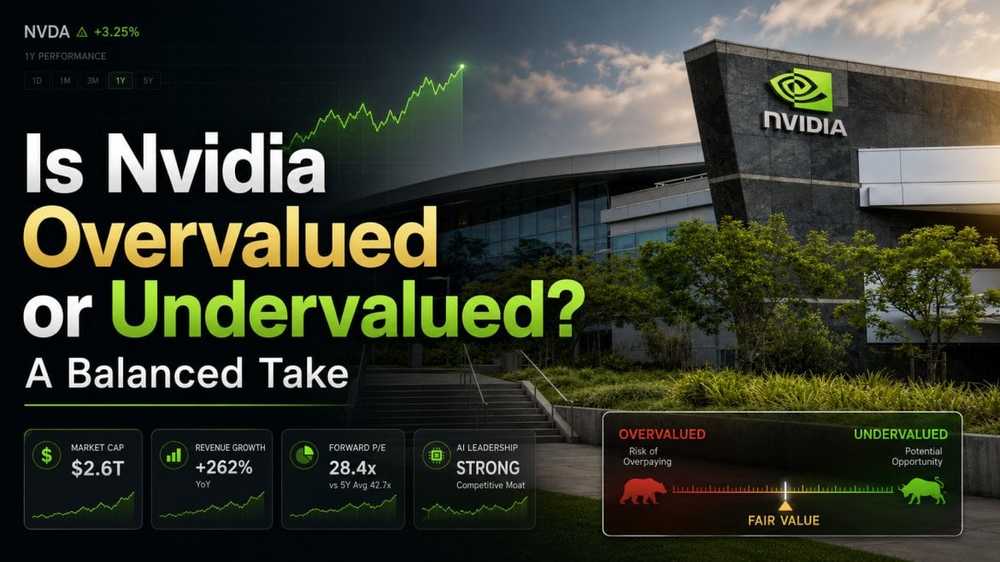
Is Nvidia Overvalued or Undervalued? A Balanced Take
Over the last few years, Nvidia (NVDA) has transformed from a beloved gaming hardware company into one of the most important infrastructure companies behind the global artificial intelligence buildout. The debate is no longer only about whether investors are excited about AI. The debate is whether Nvidia’s revenue, margins, cash flow, and competitive moat can support a valuation that has moved into multi-trillion-dollar territory.
The burning question on every investor's mind is simple: is Nvidia overvalued, or does its unprecedented financial performance justify the premium price tag?
Amid headlines asking whether the AI bubble is going to burst, investors still need a grounded way to evaluate the core issue--namely, is Nvidia overvalued relative to its cash flows, growth rate, margins, and competitive moat?
This updated analysis keeps the answer balanced. A traditional value investor can still argue that Nvidia carries significant expectation risk. But the latest numbers also show why calling it “obviously overvalued” is too simplistic: in fiscal 2026, Nvidia generated $215.9 billion in revenue and $120.1 billion in GAAP net income, and in Q1 fiscal 2027 it reported $81.6 billion in quarterly revenue with a 74.9% GAAP gross margin. NVIDIA FY2026 results;
The AI Boom: Paradigm Shift or Speculative Frenzy?
Whenever a transformative technology captures the public's imagination, financial markets tend to overreact. The spectacular rise of generative AI has led many skeptics to draw parallels to the Dot-Com crash of 2000. Today, a common question dominates financial news networks: Is the AI bubble going to burst?

The comparison is useful, but incomplete. The biggest difference between many late-1990s internet stocks and Nvidia today is earnings quality. Nvidia is not only promising future AI adoption; it is already converting that demand into extraordinary revenue, profit, and free cash flow. According to Stock Analysis data, Nvidia generated $253.5 billion in trailing twelve-month revenue, $159.6 billion in trailing twelve-month net income, and $119.1 billion in trailing twelve-month free cash flow.
That does not eliminate bubble risk. Markets can still overpay for excellent companies. The more data-driven question is not “Is AI real?” The better question is: how much future AI infrastructure growth is already priced into Nvidia stock? If the answer is “almost all of it,” even great results may not protect the stock from volatility. If the answer is “not enough,” Nvidia can remain expensive-looking and still compound earnings into its valuation.
Analyzing Nvidia's Financial Fundamentals
To truly answer the question, is Nvidia overvalued, we must look under the hood at the company's valuation metrics and revenue drivers. The updated data changes the tone of the argument: Nvidia is still priced for excellence, but its earnings growth has compressed key valuation multiples.
Valuation Metrics Breakdown
At first glance, Nvidia's market capitalization can still induce vertigo. But static market-cap headlines rarely tell the whole story for hyper-growth companies. The more important point is that Nvidia's revenue and earnings growth have been so strong that its trailing P/E ratio has fallen from extreme levels even while the stock remains expensive in absolute terms.
- Nvidia P/E ratio vs historical average: Nvidia’s historical P/E ratio was 59.32 in FY2022, rose to 119.77 in FY2023 when earnings temporarily compressed, then fell to 51.29 in FY2024, 48.51 in FY2025, and 38.30 in FY2026. As of mid-June 2026, Stock Analysis showed a current trailing P/E of 32.27 and a forward P/E of 21.20. That means the argument should not be “the P/E has recently spiked.” The more accurate argument is that Nvidia still trades at a premium, but earnings growth has made the valuation less extreme than many market-cap headlines imply.
- NVDA price-to-earnings-growth ratio:The PEG ratio is useful for high-growth companies because it compares valuation against expected growth. Stock Analysis showed Nvidia’s current PEG ratio at 0.47 as of June 2026. A low PEG does not automatically make Nvidia cheap, because future earnings estimates can be wrong. Still, it does support the bullish argument that the stock is not obviously overvalued if earnings growth remains strong.
- Evaluating tech company net profit margins: Nvidia’s profit margin has become the center of the valuation debate. Its net profit margin was 16.19% in FY2023, then expanded to 48.85% in FY2024, 55.85% in FY2025, and 55.60% in FY2026. On a trailing twelve-month basis, Stock Analysis showed a profit margin of 62.97%. This supports the premium valuation because Nvidia is no longer just a high-growth hardware company; it is a hardware platform generating software-like profitability.
Data snapshot for graph: NVIDIA historical P/E ratio and net profit margin
| Fiscal year | Revenue ($B) | Net income ($B) | Net profit margin | Historical P/E ratio |
|---|---|---|---|---|
| FY2022 | 26.914 | 9.752 | 36.23% | 59.32 |
| FY2023 | 26.974 | 4.368 | 16.19% | 119.77 |
| FY2024 | 60.922 | 29.760 | 48.85% | 51.29 |
| FY2025 | 130.497 | 72.880 | 55.85% | 48.51 |
| FY2026 | 215.938 | 120.067 | 55.60% | 38.30 |
Stock-Analysis NVIDIA financials;

The Powerhouse: Data Center Growth
Nvidia's traditional gaming revenue has taken a backseat. Today, the data center is the undisputed king.
A thorough Nvidia data center segment earnings analysis reveals why the valuation debate has become so intense. In FY2026, Nvidia’s Data Center revenue rose 68% to $193.7 billion. In Q1 fiscal 2027 alone, Data Center revenue reached $75.2 billion, up 92% year over year. Under Nvidia’s prior sub-market format, Data Center compute revenue was $60.4 billion, and Data Center networking revenue was $14.8 billion in that same quarter.
This data strengthens the bullish case: Nvidia is not being valued on AI hype alone; it is already monetizing AI infrastructure at unprecedented scale. But it also sharpens the risk. If a company is priced on the assumption that Data Center growth remains exceptional, even a slowdown from “extraordinary” to merely “strong” could reset investor expectations.
The future revenue growth projections for NVDA hinge on the sustainability of AI infrastructure demand. Bullish investors argue that the world is still in the early buildout phase of AI factories, inference infrastructure, sovereign AI systems, and enterprise AI. Bearish investors argue that the growth rate can slow as hyperscale's digest capacity, optimize existing clusters, or push more aggressively toward custom silicon. NVIDIA FY2026 results;
Industry Context and Competitive Pressures
Nvidia remains the central company in AI infrastructure, but high profit margins naturally attract fierce competition. Understanding the broader competitive landscape for artificial intelligence infrastructure is essential for long-term investors because the valuation depends not only on growth, but also on how much of that growth Nvidia can keep.
AI Chip Market Share Trends
Nvidia’s advantage is not only raw silicon performance. Its broader platform includes GPUs, networking, systems, software, developer tools, and the CUDA ecosystem. That full-stack position makes switching costs meaningful for customers who have already built AI workloads around Nvidia architecture.
However, shifting AI chip market share trends are beginning to matter more. Major cloud and consumer internet companies are investing in internal accelerators and alternative silicon to reduce dependence on one supplier. This does not mean Nvidia loses leadership immediately. It means investors should watch whether Nvidia’s growth remains platform-led or becomes more price-competitive over time.
The data-driven way to frame this section is simple: Nvidia’s current lead is visible in dollars, not only in market-share estimates. In Q1 FY2027, Nvidia reported $75.2 billion of Data Center revenue. Competitors can grow quickly and still remain far smaller than Nvidia in absolute AI infrastructure revenue. NVIDIA Q1 FY2027 results
The AMD Threat
Advanced Micro Devices (AMD) is Nvidia's most direct public-market competitor in the merchant silicon space. AMD's Instinct accelerators and EPYC CPUs give it a credible role in AI infrastructure, especially as large customers look for supply diversity and better cost-performance options.
When comparing Nvidia and AMD stock performance, both have benefited from the AI tailwind, but the business data still shows a major scale gap. AMD reported Q1 2026 revenue of $10.3 billion, GAAP gross margin of 53%, GAAP net income of $1.4 billion, and Data Center segment revenue of $5.8 billion, up 57% year over year. In comparison, Nvidia reported $75.2 billion of Data Center revenue in Q1 FY2027. AMD is a real competitive risk, but not yet an equal AI revenue threat.
The stock-performance comparison is also useful. From 2021 through 2024, NVDA dramatically outperformed AMD in the strongest AI trade years. In 2025 and 2026 YTD, AMD performed better in share-price terms, showing that investors are also pricing in a possible catch-up story. But a stock catch-up is not the same as a revenue catch-up. For Nvidia, the key risk is not simply that AMD grows; it is whether AMD, custom chips, or customer bargaining power can reduce Nvidia’s pricing power and compress margins.
| Year | NVDA total return | AMD total return |
|---|---|---|
| 2021 | +125.48% | +56.91% |
| 2022 | -50.26% | -54.99% |
| 2023 | +239.02% | +127.59% |
| 2024 | +171.25% | -18.06% |
| 2025 | +38.92% | +77.30% |
| 2026 YTD | +13.11% | +150.92% |
Total Real Returns NVDA/AMD; AMD Q1 2026 results

Macroeconomic and Geopolitical Headwinds
Even if you believe in the long-term AI thesis, you must acknowledge the external risks of investing in high-growth tech stocks. Nvidia faces unique challenges that could dictate its future valuation, especially because expectations are already high.
Geopolitical Tensions and Export Bans
One of the most pressing threats to Nvidia's revenue stream is the impact of US-China chip export restrictions. The U.S. government has implemented strict controls on the sale of high-performance AI chips to China, and Nvidia has had to design export-compliant products and adjust its outlook around those restrictions.
This risk is no longer theoretical. In its Q2 FY2027 outlook, Nvidia said it expected revenue of $91.0 billion, plus or minus 2%, and that it was not assuming any Data Center compute revenue from China in that outlook. That point should replace vague language about “watered-down” chips. The data-driven argument is that China's restrictions can reduce addressable demand even when global AI demand remains strong.
For valuation, the risk is two-sided. On one hand, Nvidia’s ability to guide for massive revenue without assuming China Data Center compute revenue shows the strength of demand elsewhere. On the other hand, the same disclosure confirms that export policy can remove a meaningful growth channel and increase uncertainty around future revenue mix.
The Cyclical Nature of Semiconductors
Investors new to the tech space often forget about the semiconductor industry's cyclicality and market cycles. Historically, the chip industry has been characterized by boom-and-bust periods driven by inventory, capacity, end-market demand, and customer ordering behavior.
The current AI cycle is different from a normal PC or smartphone cycle because hyperscale AI infrastructure spending is larger and more strategic. But it is still hardware-led demand. If customers over-order, if supply catches up too quickly, or if return on AI infrastructure spending disappoints, Nvidia could face a slowdown even without losing technological leadership.
That is why inventory, gross margin, and customer CapEx matter. Nvidia’s current margins are exceptional--Q1 FY2027 GAAP gross margin was 74.9%--but the market will watch whether that level holds as competition rises and the product cycle matures.
Market Sentiment and Wall Street Outlook
How does "smart money" view Nvidia's current price?
Looking at institutional investor sentiment on semiconductor shares, there is a distinct divide. Growth-oriented investors continue to view Nvidia as the dominant “picks and shovels” company for AI infrastructure. More valuation-sensitive investors focus on concentration risk, margin sustainability, China restrictions, and the possibility that hyperscale spending eventually normalizes.
Wall Street sentiment remains broadly positive, but it should not be treated as proof that the stock is undervalued. Stock Analysis showed an analyst consensus of “Strong Buy,” with 62 analysts and an average price target of $298.93 as of June 2026. This supports the bullish sentiment backdrop, but analyst targets can lag fast changes in market expectations, especially when a stock is tied to one of the largest technology spending cycles in the world. Stock Analysis NVIDIA statistics
Actionable Advice: How to Value Nvidia Yourself
Instead of relying solely on financial media headlines to decide if Nvidia is overvalued, proactive investors should learn how to run the numbers themselves. Here is a practical framework.
How to Calculate Semiconductor Intrinsic Value
To find a stock's true worth, financial professionals often use a Discounted Cash Flow (DCF) model. For a company like Nvidia, the model is highly sensitive to three assumptions: how long AI infrastructure growth remains elevated, whether gross margins stay near the mid-70% range, and how much free cash flow can be generated after reinvestment.
- Project Future Cash Flows: Start with Nvidia’s trailing twelve-month free cash flow of roughly $119.1 billion as a baseline, then model different growth paths. A bull case assumes AI infrastructure demand remains strong for several years. A bear case assumes growth decelerates sharply as hyperscale's digest capacity or shift more workloads to custom chips.
- Determine a Terminal Value: Estimate what Nvidia will be worth after the high-growth period. The terminal value should not assume today’s extraordinary growth forever. A more conservative model gradually lowers growth and margins toward mature platform levels.
- Discount to Present Value: Apply a discount rate that reflects interest rates, equity risk, semiconductor cyclicality, and Nvidia’s higher-than-market volatility. A higher discount rate can quickly reduce the present value of future cash flows, which is why valuation sensitivity matters.
If the calculated present value is significantly higher than Nvidia's current market cap, the stock may be undervalued under your assumptions. If it is lower, the stock may be overvalued. The key is that Nvidia's valuation is now less about whether AI is real and more about how durable the growth and margins will be.
Key Metrics to Monitor
If you are considering adding NVDA to your portfolio, or holding onto existing shares, keep a close eye on these specific indicators:
- Hyperscale CapEx: Read the earnings transcripts and guidance from Microsoft, Google, Meta, Amazon, Oracle, and other major AI infrastructure customers. Nvidia’s Data Center growth depends heavily on continued AI infrastructure investment.
- Margin Compression: Watch Nvidia’s gross margins closely every quarter. A sustained decline from the mid-70% range toward the 60% range would suggest pricing pressure, product-mix changes, export-related constraints, or stronger competition.
- Data Center Growth Quality: Do not look only at total revenue. Separate compute, networking, hyperscale, enterprise, sovereign AI, and edge demand where possible. Nvidia’s new reporting framework should make this mix increasingly important.
- Inventory Levels: In the semiconductor industry, rising inventory levels at the manufacturer or customer level can be a classic leading indicator of a cyclical downturn.
- China Exposure and Export Policy: Nvidia’s Q2 FY2027 outlook excluded Data Center compute revenue from China, so export rules should remain part of every valuation model.
Conclusion: So, Is Nvidia Stock Overvalued or Undervalued?
The debate over whether Nvidia is overvalued will not be settled overnight.
If you view Nvidia purely through a traditional value-investing lens, the stock still looks expensive. A multi-trillion-dollar market cap requires enormous future earnings power, and risks around AI spending, China export controls, chip cyclicality, AMD, custom silicon, and margin compression are real.
However, the updated data makes a simple “Nvidia is overvalued” argument weaker. In FY2026, Nvidia generated $215.9 billion of revenue and $120.1 billion of GAAP net income. In Q1 FY2027, it generated $81.6 billion of revenue, $58.3 billion of GAAP net income, and $75.2 billion of Data Center revenue. Meanwhile, its current P/E has compressed to around the low-30s on a trailing basis and low-20s on a forward basis, according to StockAnalysis.
The most balanced conclusion is this: Nvidia is not clearly cheap, but it is also not obviously overvalued if AI infrastructure demand remains durable. It is a high-quality, high-growth, high-expectation stock. The bullish case is supported by real revenue, extraordinary margins, Data Center dominance, and free cash flow. The bearish case depends on whether growth slows faster than expected, margins compress, China remains constrained, or competitors and custom chips reduce Nvidia’s pricing power.
Ultimately, whether NVDA belongs in your portfolio depends on your investment time horizon and your tolerance for volatility. Do your own research, monitor hyperscaler spending patterns closely, and avoid making financial decisions based purely on the hype--or the panic--of the day.