The AI Agent is your central hub for managing chatbot behavior - control AI responses, intent detection, contextual memory and fallback handling. It offers automation with optimized agent availability.
In today's article we will discuss the central AI Agent chatbot feature of BotSailor. Before diving into the details, let’s catch a glimpse of what our AI chatbot training system is built upon & what's there in general-
Central Control System:Manage the AI chatbot functionalities through the Enable AI Agent feature,AI Powered Intent detection, managing business hours for the chatbot’s responses & enabling contextual memory. In the Bot Manager section , under the AI Agent section, you can select your preferred AI campaign & so on.
Enable AI Trained Campaign:You can select & control the PreviouslyTrained AI Agent for Chatbot With FAQ, URL, File, Google Sheets & APIs from this section.
Want to understand the full difference between anAI Agent(chatbot management) and anAI Assistant(subscriber insights)?
👉Read our complete guide:AI Agent & AI Assistant for WhatsApp & Multi-Channel Chatbots | AI Tokens Guide
Configuring the Central Control System: "Enable AI Agent"- A Detailed Demonstration
The centralized control system for the AI Agent can be found under the Bot Manager section. This comprehensive central control system enables you to manage the chatbots activity, configuring the intent detection system, select the preferred ai campaign ensuring that it matches perfectly with your business needs & customer support strategies etc. In simple terms, this feature offers a highly customizable and intuitive approach to optimizing your chatbot's performance that maintains professional interactions & helps you maintain strict control over your chatbot. In the following sections, we’ll walk you through the steps to configure this powerful feature for your AI chatbot. Let’s get started-
Enable AI Agent
At first Go to Chatbot Manager, under the WhatsApp or Facebook Bot section, u will find the ‘AI Agent’ option. Toggle it on to configure the AI Agent with the pre configured AI Training Campaign.

After enabling the AI Agent, all the previously trained chatbots will appear here. Select your pre-created AI Training Campaign.

Enable intent detection
Enabling Intent Detection enables your chatbot to identify user queries and match them to predefined intents. By setting up Intent Detection, you create individualized interactions based on your users' requirements.
Here is what Intent Detection allows you do :
Campaign Names:Label and organize your intent detection campaigns for much easier management and monitoring.
Add Example Phrases:Define a set of example phrases for each intent to ensure recognition if users write their queries differently or with different wording.
Enable Bot Flow Trigger:Connect particular bot flows to each intent and the chatbot can offer users automated responses or predefined actions based on the recognized intention.
Enable Agent Assignment:Routing critical or complex queries to human agents for personalized support.
Enable AI Driven Responses:Create customized AI training campaigns for particular intents for your chatbot. Unlike standard bot or agent assignment options, it gives more control and flexibility to handle complicated user queries. It makes an AI training campaign for the defined intent when enabled. You then add resources including FAQ entries, URL links or customized datasets to the chatbot. This ensures the AI can respond contextually relevant and accurately to user inquiries.
Label Management:With our enhanced Label Management, you have the flexibility to both add and remove labels when an intent is detected. This allows you to automatically tag conversations for easier management, reporting, and analysis.
Add Labels:Automatically apply one or more labels to a conversation. For example, if a user asks a question about pricing, you can add a "Pricing" label, making it easy to filter and track all pricing-related inquiries.
Remove Labels:Automatically remove a label from a conversation. This is useful for clearing out old tags. For instance, you could remove a "Pending" label once a follow-up action is complete.

Sequence Management:Our new Sequence Management feature allows you to control a user's subscription to a predefined sequence directly from an intent. A sequence is a series of automated actions or communications, like an email drip campaign or a series of follow-up messages.
Subscribe to Sequence:Automatically enroll a user into a specific sequence when an intent is detected. For example, if a user's intent is "Product Interest," you can subscribe them to a series of emails with more product information and a link to schedule a demo.
Unsubscribe from Sequence:Automatically remove a user from a sequence. This is helpful for preventing unwanted communication, such as unsubscribing a user from a "Lead Nurturing" sequence once they have become a customer.
By adding these options, you get a more dynamic and powerful way to manage user interactions, ensuring your chatbot not only understands intent but also takes the right actions to guide the user and smooth your processes.For a comprehensive manual on how to begin utilizing Intent Detection and taking full advantage of its capabilities, check out our comprehensive blog -AI-Powered Intent Detection to Enhance Chatbot Efficiency
AI Agent for All Queries

When someone enables this option, the AI will reply to all customer queries, regardless if it matches the bot flow keyword/template or not. In this case the chatbot should be highly optimized and trained with all necessary input & data.
AI as a Fallback Only
If the user activates this option, the bot will only reply when the ‘No Match Reply’ is triggered. That means, when there is no match to the previous predefined bot flow, the AI reply will be activated & reply according to the training data.
Enable Contextual Memory
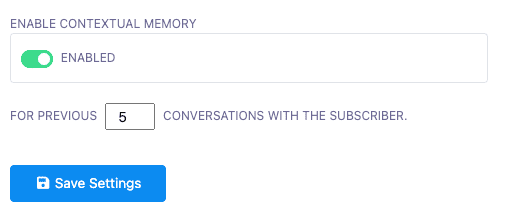
Switching on this feature the chatbot will ought to memorize the previous conversational contexts for future references. Additionally, you can configure the number of messages the chatbot will retain in its memory. For example, For previous (Number) conversations with the subscriber suggests that the chatbot will memorize the context from a selected number of messages.
Enabling or Disabling ‘Don't assign agent in business off hour’
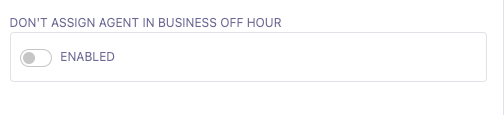
If you have a business that requires agents to be assigned to certain intents, you can use the following feature for your intent detection:
Not Assign Agent During Non Business Hours
The result is that your chatbot will accept user queries outside of business hours. If the user query matches an intent that requires an agent (more nuanced situations or tailored help), the chatbot will not route the query to a human agent after hours.
Rather, the chatbot will do one of these things:
Provide an automated response informing the user the team is not available right now.
Recommend alternate solutions, like accessing an FAQ, leaving a message or even booking a follow up during regular business hours.
Try to resolve the query without human intervention using AI Driven Responses (if enabled).
This offers uninterrupted user support while respecting agent availability.
Time for Business hours can be set up from Bot Manager' Configuration' business Hour Settings.
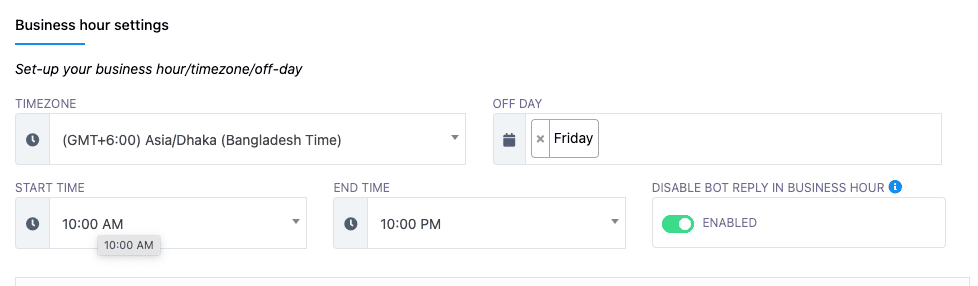
Here you set the working hours to make sure that agent assignments are made only within the specified business hours - optimizing user experience and agent workload management.
Restricted Topics 
The restricted topic option appears when the intent detection option is not disabled. Configuring this option will help your chatbot to understand what topics to avoid. The topics can be mentioned in the given box. Enabling this will ensure that the conversation remains appropriate & controlled with a more professional tone.
Response for Restricted Keywords
Set the response for restricted keywords here. Whenever a customer inputs any restricted keyword during the conversation it will respond with the predefined message. This particular response could be configured to clarify the restriction and to politely warn the user of it.
Enable Assign Conversation to Team or Department

You can enable Assign Conversation to a particular team (ex. marketing, technical service, sales) for detailed support or potential customer retention.
Typing on Indicator

Typing on indicator provides a human touch to the conversation which have much more chance to sustain a lead and channel the customer through proper media.
Delay for AI Reply

Delay for AI Reply is a phenomenal feature that takes time before generating a reply. In terms of multiple message from customer; It's smart feedback quality generates a single concise reply accumulating all the answers into one intellectual response.
One of the biggest challenges in chatbot communication is making conversations feel natural to customers. Instant replies can sometimes reveal that the response is automated, which may reduce user trust or engagement. That's where theDelay for AI Replyfeature becomes a game changer.
By introducing a short, configurable delay (from 0 to 60 seconds), BotSailor allows your AI to respond in a more human-like manner. This subtle pause mimics real typing behavior, making conversations fell more authentic and comfortable for customers-especially in sales or support scenarios where a human touch matters.
But this feature goes beyond just improving realism.
In real-world conversations, customers often send multiple messages one after another- sometimes clarifying their thoughts or adding more details. Without delay, a chatbot may respond to each message separately, leading to fragmented and sometimes less accurate replies.
With Delay for AI Reply,BotSailor intelligently waits for a short period, collects all incoming messages, and generates a single, well-structured response. This results -
- More accurate answers
- Better understanding of user intent
- Cleaner and less cluttered conversations
In short, it's not just about delaying replies-it's about delivering smarter, more human, and more effective communication.
AI Training for BotSailor's Chatbot.
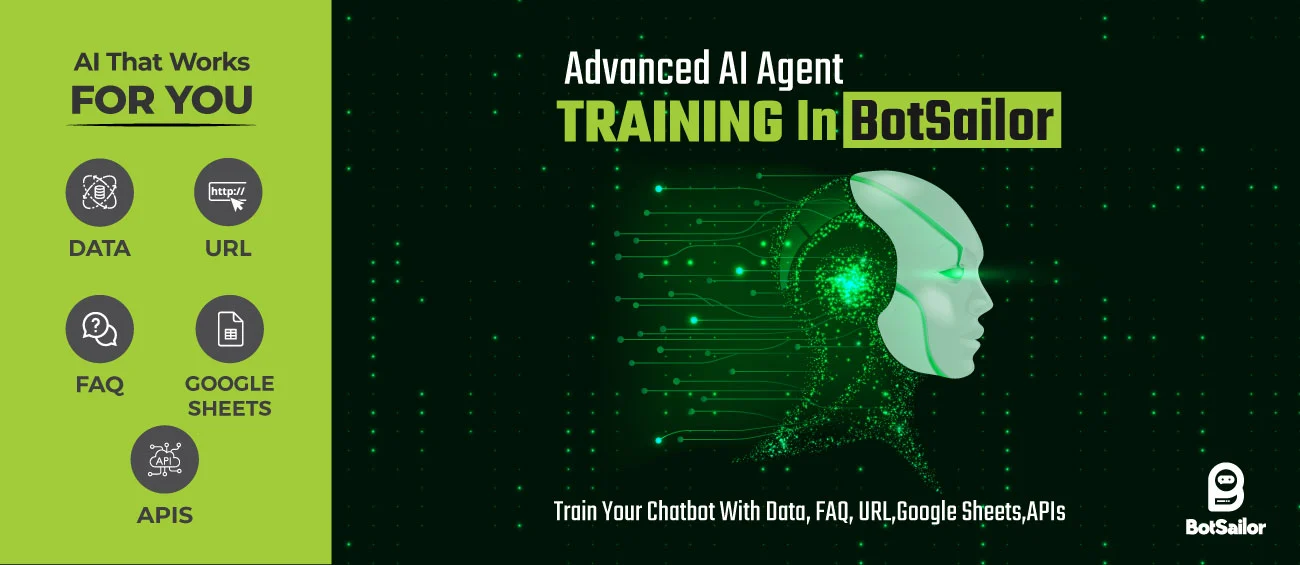
BotSailor's AI Agent could be trained to perform more intelligent, effective customer interactions. Allowing AI training means your chatbot can recognize and react to queries better. Train your chatbot with customized data, FAQs and URLs, Google Sheets, APIs to offer contextual and precise answers.
This makes your chatbot more intelligent and much more customized to your business requirements and preferences. To learn how to train your chatbot step-by-step, check out our comprehensive blog here-Train AI Agent for Chatbot With FAQ, URL, File, Google Sheets & APIs.
Conclusion
BotSailor's AI Agent enables businesses to personalize customer interactions with AI driven capabilities like intent detection, contextual memory and flexible agent assignments. Allowing these tools enables businesses to create a responsive yet smart chatbot which responds to user queries with customisable replies. Additionally, you can set business hours and agent availability to obtain an optimum AI Agent for customer experience & team efficiency.
Need complete automation or selective AI responses? With BotSailor's AI Agent, you configure your chatbot. Take the next step of customer support with BotSailor's intelligent AI capabilities & transform your business interactions.
Explore Knowledgebase:
Learn more about BotSailor Live Chat and Shared Inbox