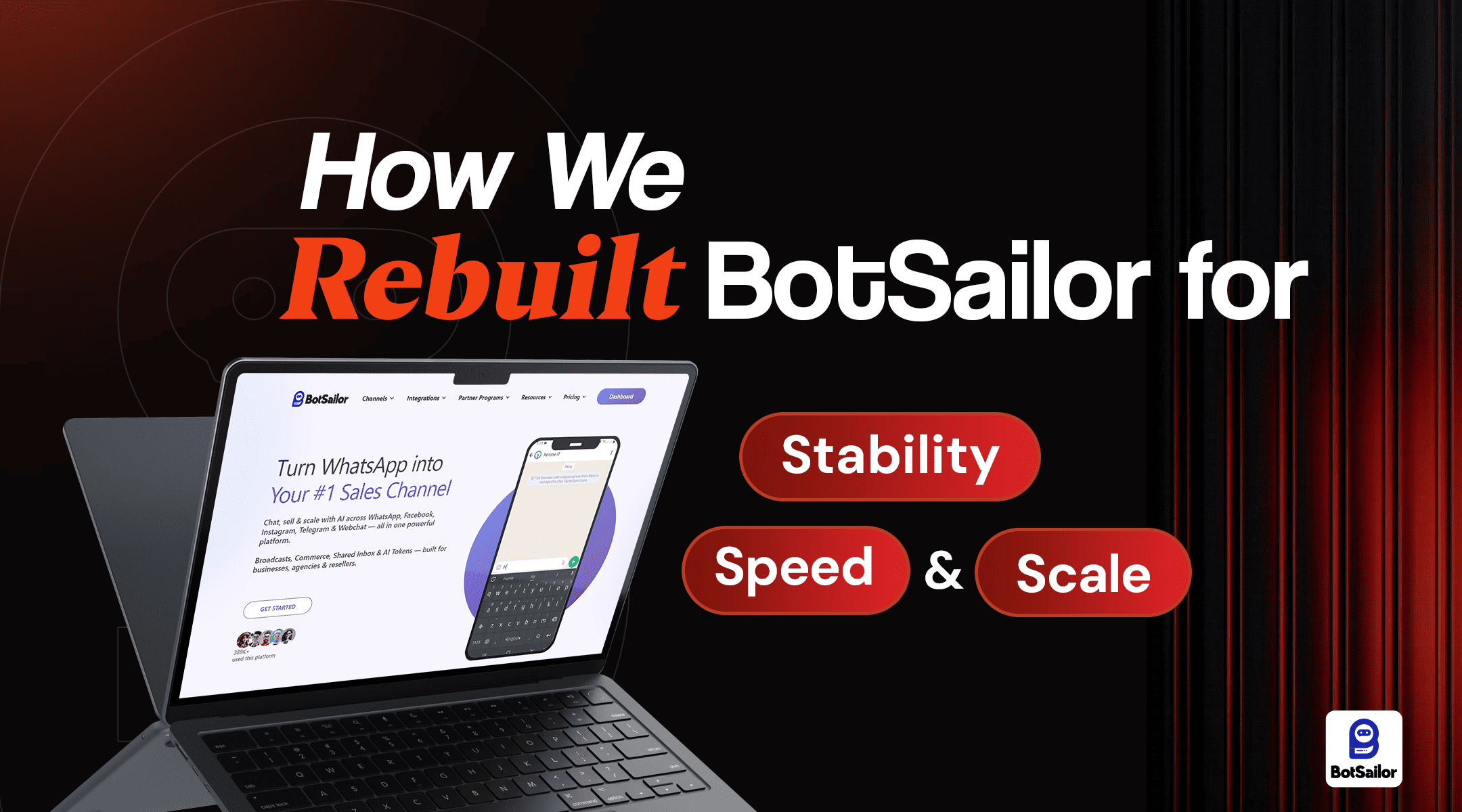
BotSailor rebuilt its backend architecture to eliminate downtime by optimizing code, databases, and server infrastructure, and by implementing fast webhook acknowledgment using a dedicated Node.js layer. Today, BotSailor operates on a multi-node, load-balanced system and is considered one of the most stable white-label chatbot platforms in the market.
Background
Like many fast-growing chatbot platforms, BotSailor faced infrastructure challenges during an earlier growth phase. High webhook volume, increasing automation traffic, and rapid user adoption put pressure on parts of the system that were originally designed for a smaller scale.
Instead of applying temporary fixes, we made a deliberate decision to rebuild critical parts of the platform from the ground up, focusing on long-term stability, performance, and scalability.
What Changed Inside BotSailor?
1. Deep Code & Database Optimization
We conducted a full audit of:
- Core application logic
- Database queries and indexing
- Queue and background job execution flow
Redundant queries were removed, slow operations optimized, and high-frequency processes redesigned to reduce CPU, memory, and database load during peak traffic.
Result: Faster execution, lower resource usage, and predictable performance.
2. Enterprise-Grade Server Architecture
BotSailor now runs on a distributed, high-availability infrastructure, including:
- Multiple high-capacity application servers
- Load balancers for traffic distribution
- Horizontal scaling to handle sudden spikes
- Redundancy to eliminate single-point failures
This architecture ensures stability even during large broadcast campaigns, automation bursts, or Webhook surges.
Why Chatbot Platforms Commonly Face Downtime?
Most chatbot platforms become unstable because of poor Webhook handling.
Here’s what typically happens:
- Platforms like Meta send webhooks in real time
- If a Webhook endpoint responds slowly or times out, Meta retries aggressively
- Retried events multiply incoming requests
- Servers get flooded, queues grow uncontrollably, and performance collapses
This is the main reason many chatbot platforms experience frequent or recurring downtime.
How BotSailor Handles Webhooks Differently (Accurate)
BotSailor’s stability comes from fast Webhook acknowledgment, not heavy processing at the Webhook entry point.
Our Webhook strategy:
- Webhooks are received by a dedicated, high-performance Node.js server
- The server sends an immediate acknowledgment to Meta
- This prevents Webhook retries and duplicate event floods
- Heavy processing is kept away from the Webhook intake layer
- Core application servers remain protected from sudden load spikes
Even if downstream processes take time, the Webhook entry layer stays fast and responsive.
This design prevents:
- Duplicate Webhook storms
- Entry-point overload
- Cascading infrastructure failures
As a result, BotSailor remains stable even under extreme Webhook volume.
Why This Architecture Is Ideal for White-Label Resellers?
For white-label resellers, platform stability directly impacts:
- Brand credibility
- Customer retention
- Revenue continuity
BotSailor is optimized specifically for white-label SaaS environments, where:
- Multiple brands operate on shared infrastructure
- Traffic patterns are unpredictable
- A single outage affects many businesses
With its optimized Webhook intake, distributed server architecture, and hardened backend, BotSailor is one of the most stable white-label chatbot platforms currently available.
The Result
- No unplanned downtime
- Faster system response times
- Stable performance under high Webhook traffic
- Infrastructure designed for long-term scaling
Today, BotSailor operates on a production-grade system built for modern chatbot workloads and reseller growth.
Frequently Asked Questions
Find answers to common questions about this topic
Yes. BotSailor has been running without unplanned downtime after rebuilding its infrastructure and optimizing webhook handling.
Most downtime is caused by slow or poorly managed webhook endpoints that trigger retry floods from platforms like Meta.
By acknowledging webhooks instantly using a dedicated Node.js server, preventing retries and duplicate traffic.
Yes. BotSailor is specifically optimized for white-label environments and supports high traffic across multiple brands safely.
Yes. BotSailor operates on a multi-node, load-balanced server architecture with redundancy.

BotSailor
Content Author


(1) Comments
molla akash
This is huge for us. Knowing the infrastructure is built for high volume makes it much easier to pitch to our bigger clients. Keep up the great work!