
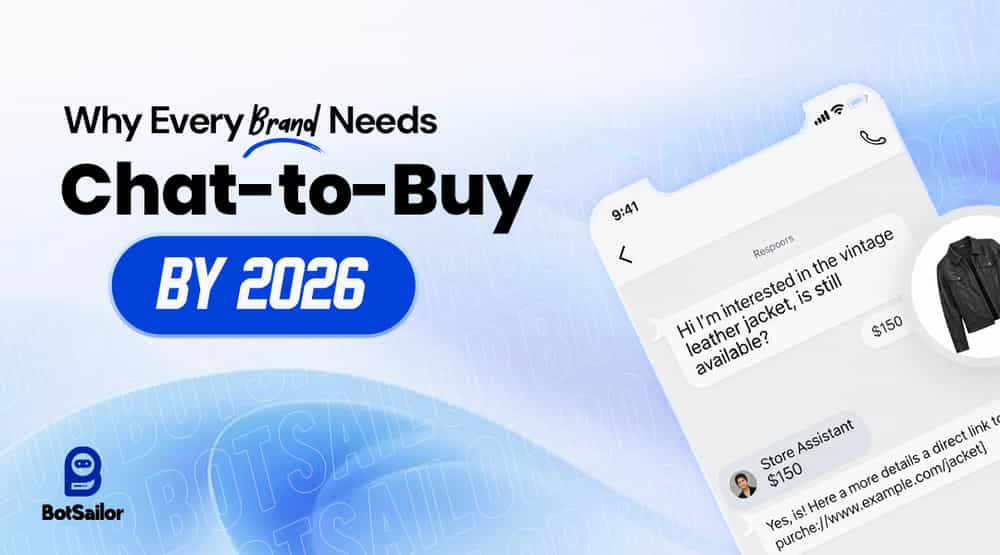
Chat-to-Buy is replacing traditional Click-to-Buy in 2026
Nowadays, customers hate to browse websites, fill forms or complete the boring checkout process. Rather they prefer to ask, decide and buy within the app like WhatsApp, Facebook or Telegram.
That’s when BotSailor comes in. It’s handy, and an Multichannel supported AI powered chatbot marketing platform that allows:
Sell inside chat directly
Lessen cart abandonment
Deliver personalized offers
Operate a 24/7 non-stop customer supports
Increase conversion rates up to 3× compared to forms or email
In 2026, the brands that win won’t have better websites—they’ll have better conversations.
Introduction : The 2026 Friction Crisis
Why is traditional click-to-buy failing the modern consumer?
For over a decade, ecommerce optimization has focused on better landing pages, faster checkout, and fewer form fields. But in 2026, companies face a paradox:
Websites are more optimized than ever – but conversions stagnate or decline.
The problem is notdesign.
The problem isfriction.
Each click-to-buy journey still forces users to :
• Switch context (social app→browser→checkout)
• Load multiple pages
• Re-enter information
• Make decisions without guidance
According to the "Baymard Institute", the global average cart abandonment rate is still ~70%, with the main reasons being:
• "Too complex/long checkout"
• "Had to create an account"
• "I didn't trust the site with my payment information"
In short,Click-to-Buy assumes patience—but the modern consumer has none.
Several studies confirm that attention deficits are exponential, not linear.
• Google's UX research shows that the probability of a bounce increases by 32% when the page load time goes from 1s to 3s
• In 5 seconds, the bounce chance increases to 90%
But speed is only half the story.
Each additional click, redirect or form field introduces:
• cognitive load
• doubt
• Danger of distraction
In messaging apps, there are zero-page loads and zero context switches.
The user is already authenticated, attentive and emotionally engaged.
That is why the question of winning in 2026 is no longer:
"How can we improve the payment user experience?"
These are:
"How can we remove the crate completely?"
Defining Change: From Static Sites to Dynamic Conversations
Websites are static in nature.
The conversation is favorable.
A website shows the same product page to everyone.
A chat experience asks:
• "What are you looking for?"
• "What's your budget?"
• "Do you want delivery today?"
This change shows that people naturally buy through conversation, not from a menu.
Messaging platforms such as WhatsApp and Telegram are no longer "support channels"; They are becoming trading platforms.
📊By 2026:
• More than 2.7 billion people use WhatsApp monthly
• Users spend 5-7 times more time on messaging apps than brand websites
This sets the stage for a new model:Chat-to-Buy.
What is “Chat-to-Buy”?
The evolution: From “Chat Support” to “Transactional AI”
Historically, chat meant:
• Frequently asked questions (FAQs)
• ticket deflection
• Increase in human support
Chat to buy represents a fundamental shift:
Chat by intent is no longer supported – it creates and fulfills intent.
Modern chat-to-buy systems can:
• Recommend products
• Check availability
• Use a discount
• Collect payments
• Trigger fulfillment
All in the same conversation thread.
This development parallels the shift from informational websites to actionable platforms powered by AI, APIs and real-time data.
Why is 2026 the year of agency trading?
We are entering the era of agent commerce – where AI not only reacts, but acts on the user's behalf.
Unlike traditional chatbots:
• Agent AI can perform multi-step actions
• It can call APIs, update inventory and trigger workflows
• It understands signals of readiness to buy, not just keywords
Gartner predicts that by 2026:
30% of digital commerce interactions will be handled by autonomous AI agents
In chat-to-buy it means:
• AI does not say "Click here to buy"
• The AI says: "I've reserved one for you - should I continue?"
That difference is transformative.
The psychology of "in-app" purchases
Consumers don't just want speed, they want consistency.
Psychological research calls this "flow conservation":
• Every app breaker breaks mental speed
• Each diversion introduces other ideas
Protected messaging apps:
• Identity (no login)
• Trust (familiar user interface)
• Attention (no competing tabs)
Meta's internal studies show that the in-thread trading experience outperforms web referrals in both:
• Degree of implementation
• Customer satisfaction
This explains why users increasingly like it:
• e.g
• ask
• make decisions
• make payment
Without leaving the chat.
5 reasons why your business needs chat to buy
1. Instant gratification for Gen Z and Alpha
Gen Z grew up with:
• Same day delivery
• One-touch payment
• Everything on request
Salesforce study shows:
• 73% of Gen Z customers expect immediate responses
• 64% abandoned brands after a slow or complicated purchase journey
Chat-to-Buy satisfies the “right now” expectation—without queues, pages, or forms.
2. Hyper-personalization in real time
Unlike websites, chat looks:
• User questions
• Objections
• Priorities
• Tone of voice
This allows for real-time personalization, not guesswork.
McKinsey reports that personalization:
• Increase conversion rate by10-15%
• Increase revenue by40%in digital-first businesses
Chat-to-Buy turns conversation data intoinstant sales leverage.
3. Higher ROI than email or online forms
Average Email Marketing Conversion Rate:~2-3%
Landing page form:~1-2%
Conversational trading streams regularly receive:
• 5-15%+conversion rate depending on vertical
Because chat captures users at the moment of intent, not days later.
4. Reduction in abandoned wagons
The shopping cart is abandoned when a user:
• be distracted
• Loses self-confidence
• Decide to "think later"
Closes the chat-to-buy loop immediately:
• Questions answered on the spot
• Objections resolved in real time
• Checkout completed before doubts arise
This is conversion compression – reducing the time from intent to payment.
5. A 24/7 global sales floor - without hiring more staff
Chat-to-Buy System Scale Unlimited:
• No working hours
• No language barrier
• No linear cost increase
AI handles:
• 80-90%repeat sales calls
The man only advances when:
• Trust matters
• Need to negotiate
• High-value deals arise
How BotSailor Powers the Chat-to-Buy Revolution
Chat-to-buy is not just a concept – it requires infrastructure, orchestration and intelligence to work reliably at scale. This is where platforms likeBotSailoreases the journey.
Unlike basic chatbot tools,BotSsailoris designed as a transactional conversation engine, not a messaging plugin.
The Omnichannel Advantage: OneShared Inbox, Multiple Platforms

At present marketers don’t really rely on a single channel. They need their present on every popular platform. That’s why BotSailor has come up with the most popular platforms like Facebook, WhatsApp, Instagram, Telegram and Webchat. So that, they can reach their customers from a single unified shared inbox and don’t miss a single client.
A single customer might:
Discover a product onInstagram
Ask questions onWhatsApp
Complete the purchase usingFacebook
Managing these separately createsfragmented customer journeys and lost intent.
BotSailor unifies Chat-to-Buy across:
WhatsApp
Facebook
Instagram
Telegram
Webchat
All fromone centralized inbox, one automation logic, and one customer profile.
This matters because omnichannel customers:
Spend30% moreon average
Show higher lifetime value than single-channel buyers
Chat-to-Buy succeeds when conversationscontinue fluidly, not restart on every platform.
WhatsApp Catalog Integration: Turn chat into a storefront

WhatsAppis no longer just a messaging app – it's becoming an e-commerce platform.
Meta officially supports:
• Product catalogue
• Product card
• Browser experience in chat
BotSailor’sbenefit from:
• Synchronization of products directly to the e-commerce platform
• Present structured product cards in chat
• Allows users to browse without leaving the conversation
It ends:
• Delay in loading the landing page
• Context switching
• Decision delays.
The result is trading inside the meditation, not outside it.
BotSailor Flows: From Greeting to Payment—No Code Required
When trading becomes complex, traditional automation tools break down.
The chat-to-purchase flow must handle:
• Branching questions
• conditional logic
• Inventory check
• Payment decision
• Human handover
BotSailor's Visual Flow Builder allows teams to:

• Visually map the entire purchase journey
• Adopt path based on user intent
• Trigger actions mid-conversation (API call, webhook, CRM update).
For companies, this means:
• quick use
• No dependency on developers
• Rapid iteration of sales strategies
Smart Intent Detection: Knowing When to Sell—and When Not To

One of the biggest mistakes in automation is selling too early.
A user asks:
"Is the sale going on?"
Very different from:
"How much does it cost after the discount?"
BotSailorusesIntent Detectionlogic:
• Separate curiosity from preparation for purchase.
• Postponement of the sale until signals of intent appear
• Escalate complex objections to people when necessary
This mirrors how high-performing sales teams work – except it happens immediately and at scale.
According to Accenture, companies that align the timing of engagement with customer intent see up to 20% higher conversion rates
Chat-to-buy isn't about pushing – it's about recognizing readiness.
Step 1: Natural Language Queries
A customer reports:
"Do you have this customized package?”
This message immediately provides:
• Product interest
• Different priority
• Signaling of purchase intent
Unlike web filters, language reveals intentions without obstacles.
Step 2: AI-Driven Confirmation + Product Card

BotSailor:
Checks inventory via webhook
Confirms availability
Sends a product card with:
Image
Price
Variant
CTA buttons
At this moment, the user has everything needed to decide—without browsing.
Step 3: In-Chat “Buy Now” Action
• Checks inventory via webhook
• Confirms availability
• Sends a product card with:
·Picture
·Price
·Variant
·CTA button
At this point, the user has everything they need to make a decision – without having to surf.
Step 4: Real-Time Store Sync & Fulfillment
Real-Time Store Sync and Fulfillment
BotSailor instantly syncs with:
• Shopify
• woocommerce
The order data is:
• Logged in
• Inventory updated
• The fulfillment has begun
From the customer's perspective, the transaction appears seamless – almost invisible.
This is the ultimate goal of chat-to-buy:
Make shopping feel like a continuation of the conversation, not a boring task.
Overcoming the "trust gap" in conversational trading
Despite the speed and convenience, one concern remains:
"Can I trust purchases in chat?"
Trust is the last hurdle – and the most important.
, Secure payments and data protection in 2026
Modern chat-to-buy platforms must comply with:
• End-to-end encryption standard
•GDPR and regional data protection laws
• Platform-specific trading guidelines
WhatsApp messages are end-to-end encrypted by default
BotSailor provides:
• Payment processing takes place through secure, verified gateways
• Sensitive data is never stored in chat messages
• Webhooks and APIs follow modern authentication standards
In other words, chat-to-buy is not "less secure" than online shopping - it is often more controlled, because there are fewer systems involved.
, Human-in-the-loop: Knowing when AI should step aside
Not all sales should be automated.
High value purchases often require:
• conversation
• Customization
• Emotional security
BotSailor supports Human-in-the-Loop (HITL) workflows:
• AI handles search and qualification
• When does the man step:
·Initially provides the price details
·For further inquiry an agent can step in
·Customized requirements arise
·Requires security of trust
·For providing product demo
IBM research shows that hybrid AI + human models outperform fully automated systems in terms of both conversion and satisfaction
Chat-to-buy is successful when automation supports people, not replaces them.
Conclusion: Future-proof your income in 2026
The lessons from the past decade are clear:
Better sites didn't fix the conversion.
Conversations will be better.
Chat to buy isn't a trend – it's a reaction:
• Narrowing of attention span
• Message first behavior
• Demand for immediate satisfaction
Businesses that continue to optimize pages and funnels will compete for speed improvements measured in milliseconds.
Companies that embrace chat-to-buy will compete for experience improvements measured in seconds and emotions.
Don't build a better website. Create better conversations.
Websites explain.
Conversation persuades to sell.
In 2026, the winning businesses will be those that:
• Meet the customers where they are
• Remove unnecessary steps
• Replace friction with flow
Chat-to-Buy isn't about the hard sell – it's about making the purchase easy.
Final Thoughts
The business that makes shopping feel comfortable will always win the market.
And in a world where attention is the rarest currency,
Conversations is the most powerful payment site ever created.