Last Updated : 2 Feb 2026
1. Introduction: Why Search Is Changing Forever
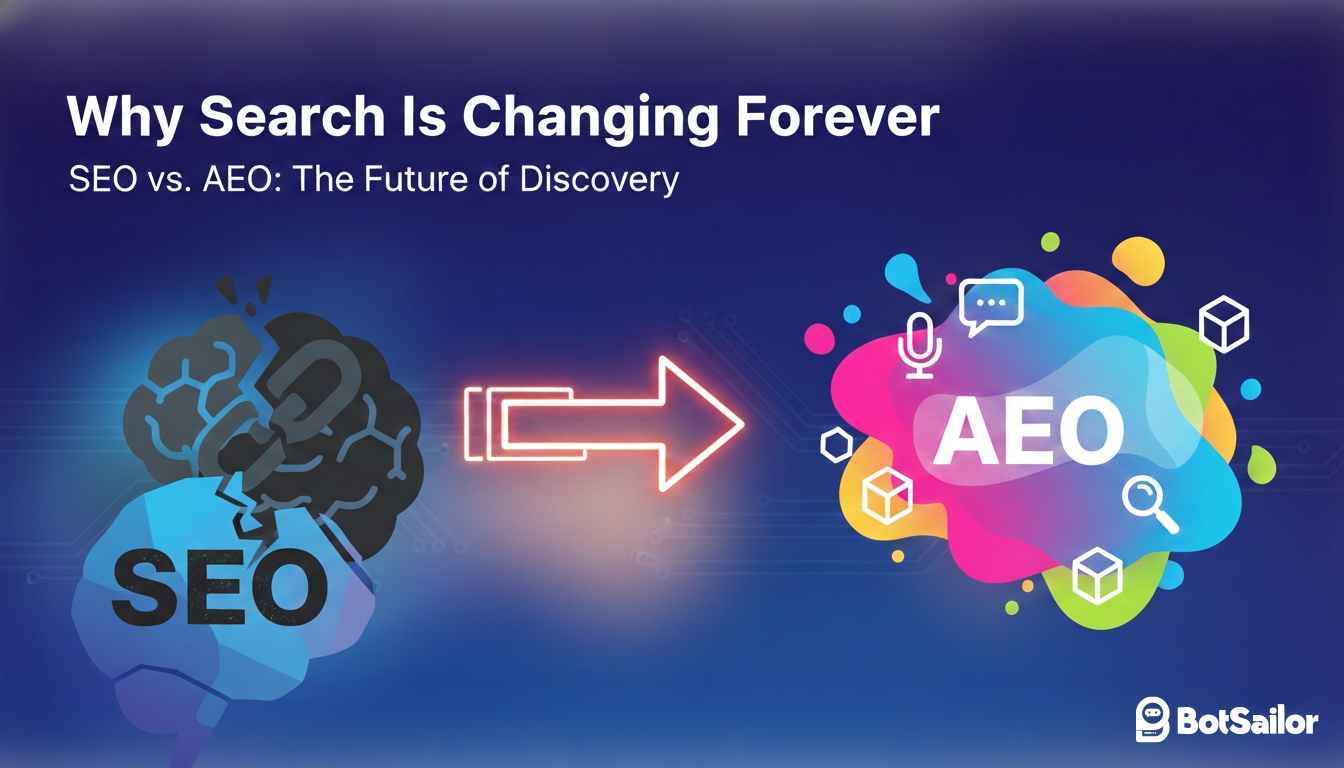
SEO has always been all about placing yourself in a ranked list whereas AEO (Answer Engine Optimization) is truly being acknowledged as the answer to the AI Engines (Chat GPT, Gemini, Perplexity, Deepseek).
For more than two decades, search engines worked the same way:
- Users type Keywords
- Search engines ranked web pages
- Users clicked links
That model is breaking.
In 2024–2025, generative AI systems began answering questionsdirectly, often without requiring users to click a single link. Platforms such asChatGPT,Google(Search Generative Experience), andMicrosoft BingCopilot are transforming how information is discovered.
Search is no longer aboutfinding pages.
It is aboutgetting answers.
This shift is exactly whyAnswer Engine Optimization (AEO)has become one of the most important digital strategies going into 2026.
2. What Is Answer Engine Optimization (AEO)?
AEO (Answer Engine Optimization) is a strategic process of creation and structuring digital contents to be enlisted as the primary source for AI-driven platforms. Different than traditional search, it emphasizes on providing direct answers that AI engines can easily filter, cite and provide users in conversational interfaces.
Answer Engine Optimization (AEO)is the practice of structuring and publishing content so AI-powered answer engines can:
- Understand it clearly
- Trust it
- Reuse it directly as an answer
Unlike traditional SEO, AEO is not about rankings—it is aboutretrievability and credibility.
Simple definition:
AEO is optimizing your content to become the answer used by AI systems.
Examples of answer engines:
- ChatGPT
- Bing Copilot
- Gemini
- BlackBox AI
- DeepSeek
- Perplexity AI
3. Why is AEO Important in 2026?
When a user searches in an AI based engine, there is no place for page two. There’s no links. In most cases, very few product sets and few recommendations. At most they provide one summary.
AI systems find out the clearest, standard, optimized structure alongside trustworthy information. If that doesn’t scale up with your content; no matter how your SEO foundations are it will not pop up to the Engines. It is not an SEO-add on. It’s a more robust capability for any brand which wants visibility or gets themselves enlisted in a world where zero-click search is the prominent user behavior.
Three major shifts have upgraded AEO from “Interesting” Trend” to a “Burning Question”.
- No-click search is the Standard:According to SparkToro’s 2024 Zero-click Search Study, almost 60% of Google searches end without a click to an external website. AI Engines summarize the answer themselves and move on.
AI Flags make the weak brands risky to surface:With inconsistent or incomplete data, AI models flag your content and engines avoid citing you altogether. It mitigates the risk by providing consistent, verifiable and more structured
AI Engine shows fewer sources:GEO summit's 2024 research shows that AI engines cite 2-3 sources on average which is far less than traditional search engines that makes them as a more credible source.
4. From SEO to AEO: What has changed?
Traditional SEO rewarded:
- Keywords
- Feedback loops
- Side authority
AEO prices:
- Clear explanation
- Structured response
- Relevant facts
- Reliable source
Main changes:
- SEO optimized for algorithms
- AEO optimizes for language models
- This is a fundamental change, not a trend.
5. How AI search engines really works?
AI search engines rely on trained large language models (LLM):
- Public web content
- Licensed data
- Human-rated data
- Reliable reference material
They don't crawl your website in real time like Googlebot.
Instead, they do:
- Identify entities (companies, products, concepts)
- Find patterns in many sources
- Choose the answers that are:
- Ready
- Is repeated continuously
- Low risk presentation
This is why AEO is about clarity and consensus, not tricks.
6. Why AI search is replacing traditional search behavior
The behavior of users is changing rapidly.
According to Statista, the global use of AI tools has surpassed 1.8 billion users by the end of 2025, with conversational AI as the fastest growing category.
Gartner's forecast predicts that by 2026, 25% of traditional search traffic will be lessened due to Chat Interfaces and AI Search Engines.
Meanwhile:
- Users tends to like direct answers
- Users ask descriptive as well as long questions
- Users trust AI summaries more than scrolling search engine pages.
This is not imaginary - it is already happening.
7. Real Statistics that prove AEO matters
Here areverified, industry-backed statistics:
- The number of users hasincreased to 58%who are now using AI-powered tools to research products or services (PwC, 2024)
Questions based (Google internal) or conversational search has nowincreased to 70%
AI generated search is proven trustworthy to 40% of users more than traditional search engines (Salesforce State of AI, 2024)
Structured and optimized FAQ and schema contents tend to 35% higher AI visibility in generative search tests (Search Engine Journal, 2024).
60% of Google searchesare Zero-click searchesmore accounted for meaning users never visited a website at all (SparkToro)
These numbers confirm one thing:
Visibility without clicks is now the new competition in the market.
8. How ChatGPT and AI Models Choose Answers?
AI systems select answers based on:
1. Content Authenticity
Is the brand or concept clearly defined?
2. Repetition Across Different Sources
Are the same facts or contents repeated consistently on different sources?
3. Answer Quality or Format
Does the content directly answer questions of the user?
4. Risk factor
Is the information safe, neutral and factual?
5. Credible Sources
Does the content sound beneficial to the user or they tend to learn something?
**If your content reads like marketing copy, it is far less likely to be reused.
9. Key Functions of a Strong AEO Strategy
1. Answer-First Content
Key content to note, every page should start with a direct question’s answer.
2. Question-Based Headings
Use headings like:
- What is it?
- What does it mean?
- How does it work?
- Who should use it?
- How can it be beneficial to you?
3. Structured Data
Schema should be followed:
- FAQ Page
- How To Page
- Product
- Organization
4. Consistent Description of Brands
You should list the service or products of your company same way everywhere.
5. Third-Party Validation
It’s better if other’s (different sites/ user reviews) say about your products or services rather than you say about yourself.
10. AEO vs SEO: Side-by-Side Comparison
SEO-is not completely gone, but it’s truly not enough now a days.
11. AEO for SaaS, E-commerce, and Service Based Businesses
1. Rewrite key pages using a direct Q&A structure
- Question headers should be clear
- Shortens 2-4 sentences on answer
- Provide definitions and summaries
- FAQ schema
2. Make your entity footprint across the web
- Apple maps
- Bing places
- Google maps
- Google business profile
- Industry specific profiles
3. Fixing product data governance
- Attributes
- Product titles
- Materials
- Descriptive care instructions
- Benefit statements
- Following naming conventions
4. Implement schema accordingly
FAQ schema, product/ service schema, Article schema; these are not optional anymore.
5. Build proper authority not just increase the content volume
- Interlinked topic clusters
- Expert-led guidance
- Problem/ solution frameworks
- Category level educational contents
6. Monitor your brand in AI engines quarterly
- Hallucination handling
- Missing categories
- New content opportunities
- Where you appear
12. How to Prepare for AI Search in 2026
By 2026:
- AI-based/ focused questionnaires will dominate search results
- Mentioning brand names or their products/ services value more than backlinks
- Content with improper structures will disappear
Preparation checklist:
- Making definition libraries
- Focus of publishing comparison contents
- Don't forget to add schema to your contents
- Provide independent mentions to different sources
- Think like you are providing or helping others; stop being an advertiser.
13. Final Thoughts: AEO as a Long-Term Strategy
Answer Engine Optimization is not a hack or something you can do with following some shortcuts.
Rather it is aphilosophy shiftthat eventually affects your perception of business.
The brands that educate the users; are the brands that should be in the limelight of the AEO.
In the AI search era,being righteous, transparent, and trustworthy beats being loud.
Frequently Asked Questions
Find answers to common questions about this topic
AEO is optimizing content and brand presence so AI search engines can use your content as direct answers and recommend your product confidently.
No. AEO builds on SEO. SEO helps you get discovered and indexed; AEO helps you get quoted and suggested.
Because a large share of searches end without website visits—SparkToro reported majority zero-click behavior in both the US and EU in 2024.
Studies and analyses indicate users click less when AI summaries appear, and CTR can drop on queries with AI Overviews.
You can see early movement in 8–12 weeks (better retrieval and citations), but becoming consistently recommendable typically takes 3–6 months of structured publishing plus third-party signals.
“Alternatives” and “comparisons” pages, plus strong documentation and FAQs.

Ahmed Nahian
Content Author


(0) Comments