
Hey there!
WhatsApp is the world’s most popular messaging app, with more than 2 billion people using it around the globe. The true power of WhatsApp Marketing lies in Broadcasting—the ability to proactively reach your customer with near-perfect open rates is a game changer. In 2026, customers will move from product discovery to checkout entirely within a chat.
Don’t just send messages—create a fully native In-App shopping experience. With BotSailor, your e-commerce brand can use WhatsApp Catalogs for quick product browsing and In-App Payments for easy, one-tap purchases. Skip external links and turn every chat into a sales opportunity.
BotSailor by Xerone IT is a Meta-approved chatbot builder for WhatsApp, Facebook, Instagram, Telegram and Webchat. It offers 24/7 automated chatbot support which is free for up to 1000 subscribers. It helps you to increase your business by improving online social media marketing.
In this blog, I will show you how you can send broadcast messages to WhatsApp using BotSailor.
Here's a video tutorial if you'd like to learn by watching:
How to Import WhatsApp Subscribers to BotSailor (Step-by-Step)
Before broadcasting, ensure your subscriber list is updated. BotSailor offers multiple options for importing subscribers:
Importing Subscriber through CSV File
- Navigate to the WhatsApp Subscriber Manager in the BotSailor dashboard.
- Select your WhatsApp account.
- Click on the Option button and choose Import Subscribers .
- Download the sample CSV template, modify it with your data, and upload it.
Importing Subscriber through Google Sheet
- Connect your Google account to BotSailor.
- Select the Google Sheet containing your subscriber data.
- Map the columns (e.g., phone numbers, names, or custom variables).
For detailed steps, visit: How to Import WhatsApp Contacts from a Google Sheet
In this blog, I will mainly discuss how to broadcast Messages to WhatsApp Subscribers UsingMessage Templatesin BotSailor. But before that you need to understand some ground rules set byMeta.
What is WhatsApp's 24-Hour Rule?
The 24-hour rule is a Meta policy that limits businesses to a 24-hour window to send free-form messages after a user contacts them. Once this window closes, standard messaging is blocked to prevent spam and ensure a high-quality user experience.
What is a Message Template?
A Message Template is a standardized message format required to contact users outside the 24-hour window. These must be categorized (Marketing, Utility, or Authentication) and pre-approved by Meta.
How BotSailor Helps: You don't need to be a developer to get this approval. You can create and submit Message Templates directly within the BotSailor dashboard. BotSailor handles the technical submission to Meta, allowing you to get your templates verified and ready for use in minutes.
Why are Message Templates Needed for Broadcasting?
Templates are the only legal way to bypass the 24-hour limit. Since most broadcast audiences haven't messaged you recently, you need a BotSailor-approved template to:
Reach "Inactive" Users: Legally message customers who last chatted over 24 hours ago.
Re-open the Conversation:If a user replies to your template broadcast, the 24-hour timer resets, allowing you to chat freely again.
Ensure Delivery: Using approved templates prevents your number from being flagged as spam during mass campaigns.
Types of WhatsApp Message Templates
There are three types of message template categories in BotSailor:
Utility message templates: These templates are used to send messages that are related to a specific transaction, such as a shipping confirmation or a payment receipt.
Authentication Message Templates: Authentication Message Templates are specialized, highly secure message formats used by businesses on the WhatsApp Business Platform (API) to verify a user's identity.
Marketing Message Templates: These templates are used to send messages that promote your products or services.
Creating WhatsApp Broadcast Campaign for Subscriber (out-side 24 hour)
To create a message template and broadcast it to inactive users only, follow these steps below:
Step 1: Creating Message Templates
- From the BotSailor's dashboard, go to WhatsApp Bot from ChatBot Manager and then select your Bot Account.
- Then go to the Message Templates options.
- Click on the Create button.
- Select the type of message template.

- Enter a name in the TEMPLATE NAME field for your message template.
- Select Language from the LOCALE field.
- Select Header Type from the HEADER TYPE list field.
- Enter the text of your message in the MESSAGE BODY field.
- If you want to add any variables ( Custom Fields /Built-in Variables/Name) to your message, click on the particular button.
- Additionally, you may provide text for the footer in the FOOTER TEXT field.
- You can also set the button from BUTTON.
- Finally, click on the Save button.

Step 2: Creating Broadcast Campaign
Once you have created a message template, you can broadcast it to your subscribers (Inactive or Imported subscribers):
- Go to the BotSailor Dashboard .
- Click on the Broadcasting from the side bar.
- Click on WhatsApp Broadcast.
- Then click on the Create button.

- A visual bot flow builder will appear as soon as possible. There is an Action button and a Start-Bot-Flow in the canvas.
- However, instantly, a Configure Action Button form will show on the top-right side of the canvas.
- Give a name for the campaign in the Campaign Name field.
- Select the Anytime radio button. Instantly, the Select template field will occur.
- It will show the targeted Subscribers.
- Select the template from the list in the Select template field.
- Optionally, you can add Include/Exclude label id(s). You can also set the Sending time if you want.
- You can send it right away or you may set a scheduled time.
- By choosing the Send later button, you will fill up the Schedule time and Time zone fields.
- Click the Ok button.
- Now, to configure the Start-Bot-Flow, double-click on it to give the name for it and hit the Ok button.
- Finally, save the campaign by clicking the Save button.

It is noted that as soon as we save, the campaign will be created and the broadcast messages will be sent right away.
Now, you can see it in the broadcasting list. If you have done all successfully, the broadcasting campaign status will be successful.
Creating WhatsApp Broadcast Campaign for Subscriber (in-side 24 hour)
From the Visual Flow builder, just select the 24 hoursradio button. This will enable broadcasting to active users only. It will also show the total number of targeted subscribers.
For active users (who have sent messages in the last 24 hours), you can send any kind of message, and you don't need any message templates this time.

We can optionally include or exclude subscribers by using a label. For example, if you want to exclude subscribers with a certain label, then you will add that label in the exclude field. Finally, click on the Ok button.
Now, double-click on the Start Bot Flow .
Give a name for it and click on the Ok button.
Now, you can add any message (Text, Image, Audio, Video, File, Interactive, Condition, etc.) according to your needs with the Start Bot Flow .
Finally, just savethe campaign. That’s it; the broadcasting campaign will start sending messages to subscribers.

How do I Track My WhatsApp Broadcast Campaign Performance?
After your campaign goes live, BotSailor gives you an analytics dashboard to track how well it is doing. By checking these results, you can see how customers are engaging and improve your future marketing plans.
To see your results, go to the Broadcasting option from the left side panel and then WhatsApp Broadcast. You will find a list of your broadcast campaigns along with a summary of how each one performed.
Understanding the Broadcast List View
The main dashboard shows a quick overview of all your campaigns, as you can see in the image below.
Campaign Status: Quickly check if a campaign is marked as Completed, Pending, or Processing.
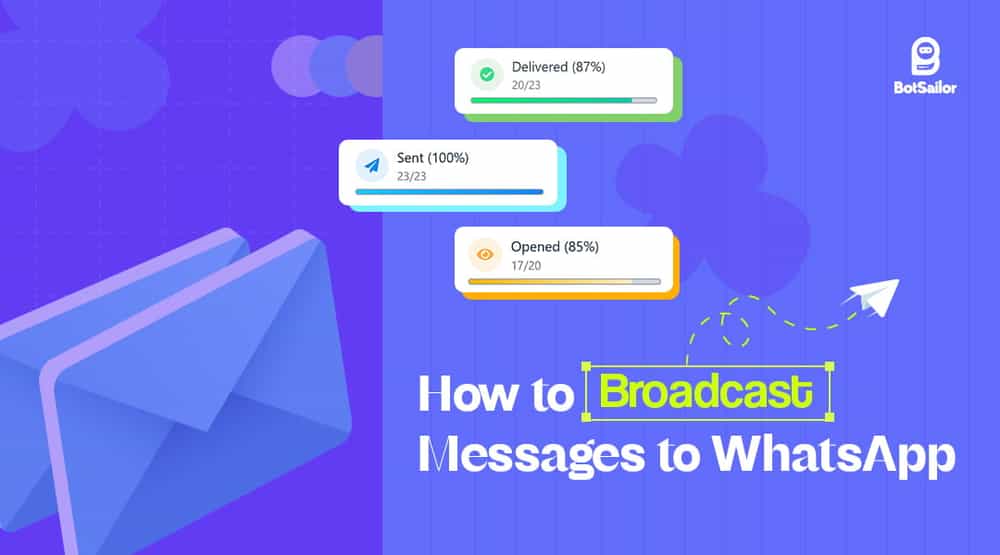
Real-time Stats: Monitor the number of messages sent, delivered, opened, and see how many users were not reached.
Quick Action Buttons
View Report: Click to see a detailed breakdown of that campaign.
Download Report: Export your campaign data as a CSV file to review offline or share with your team.
Delete: Use this option to delete any unnecessary campaigns.
Resend Failed Messages: If some messages failed because of connectivity issues, you can try resending them with one click.

Deep Dive: The Campaign Report
Click the View Report icon to open a detailed pop-up with in-depth data for that broadcast, as shown in the image.
Campaign Summary: See which template was used, the targeted labels, and any filters applied, such as the Recent Subscriber Filter or Added After/Before dates.
Delivery Funnel: View a visual breakdown of how many messages were delivered and how many were opened by your customers.
Individual Subscriber Logs: Below the summary, you'll find a list of every contact reached. This section shows:
- Chat ID/Name: The person who received the message.
- Status: Shows if the message was read.
- Timestamps: The exact times when the message was sent, delivered, and opened.
- Response/Message ID: The unique Meta identifier for each message sent, so you have full transparency for your delivery.

Tips for Maximizing Your Broadcasts
Use Personalized Messages
Personalized broadcasts achieve higher engagement rates. BotSailor allows you to include dynamic variables like names, order details, or custom fields.
Learn how to create personalized broadcasts in this guide: WhatsApp Broadcasting with Personalized Variable Data
Combine CSV and Google Sheets for Contact Management
Using both CSV files and Google Sheets gives you flexibility in managing your contacts. For instance:
- Use Google Sheets for real-time updates and team collaboration.
- Use CSV files for bulk imports and backups.
For more information, visit: How to Import WhatsApp Contacts from a Google Sheet
Leverage the "72-Hour Free Window" Strategy
In 2026, the best way to save on Meta fees is by using Click-to-WhatsApp ads. When a user enters your chat via an ad from Facebook or Instagram, Meta provides a 72-hour free messaging window.
- Use this 3-day window to send follow-up broadcasts, educational content, or special offers without paying extra per-message fees.
Drive "Zero-Click" Conversions with WhatsApp Flows
Don’t force your customers to leave WhatsApp to fill out a form or book an appointment. Use WhatsApp Flows within your BotSailor campaigns to embed:
- In-Chat Forms: For lead generation or feedback.
- Booking Calendars: For service-based businesses.
- Product Pickers:To select sizes or colors directly. The fewer steps a customer takes, the higher your conversion rate will be.
Interactive Buttons: CTA vs. Quick Reply
Static text is dead. Every broadcast should include interactive elements:
- Use these for "Buy Now" links or "Call Support" buttons.
- Use these (e.g., "Interested," "Not now," or "Tell me more") to let users respond with one tap. This triggers the 24-hour window, allowing you to continue the conversation for free.
Clean Your List Regularly
A high "Unreached" rate in your BotSailor Reports (as seen in the tracking section) can hurt your quality rating.
- Regularly export your campaign reports and remove numbers that consistently show as Failed or Unreached to keep your sender reputation healthy and avoid being flagged by Meta.
Practical Use Cases
Here are a few ways you can use message templates in BotSailor:
Automated Reminders :Set up reminders for appointments or payments using templates and dynamic variables. Learn how to automate messages using Google Sheets here: Send WhatsApp Messages from Google Sheets Changes
Event Updates : Share real-time updates with attendees for webinars, meetups, or product launches.
Order Confirmations :Send personalized order details to customers immediately after purchase.
In conclusion, I say that if you are looking for a way to broadcast messages to WhatsApp, using message templates in BotSailor is a great option. You may also see: How to Broadcast Messages to WhatsApp using Message Template from BotSailor
Next Steps
Ready to take your WhatsApp marketing to the next level? Explore these resources:
WhatsApp Broadcasting with Personalized Variable Data
How to Import WhatsApp Contacts from a Google Sheet
By leveraging BotSailor’s features for contact import, message templates, and dynamic personalization, you can create impactful campaigns that resonate with your audience. Start broadcasting today and experience the power of effective WhatsApp marketing!
Read Knowledgebase on WhatsApp, Facebook & Telegram Broadcasting -https://botsailor.com/help/en/folder/7
Related Articles:
WhatsApp Broadcasting List: A guide to WhatsApp Bulk Messaging (2024)
WhatsApp Broadcasting with Personalized Variable Data
Telegram Broadcasting on BotSailor: Step-by-Step Guide to Creating & Scheduling Broadcasts